
Assignments your students answer out loud
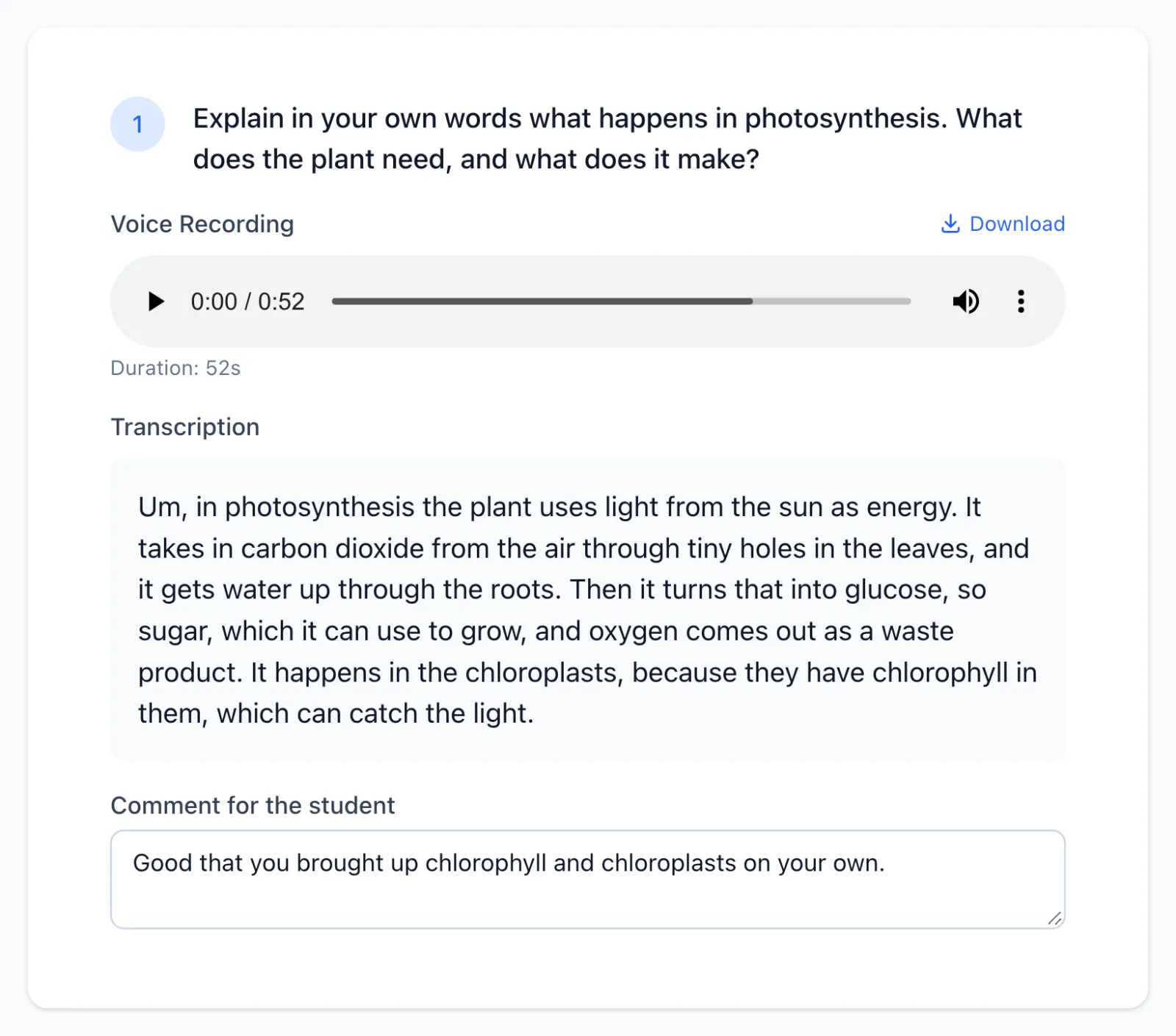
A chatbot can write the essay in seconds. A spoken answer, with the clock running, is much harder to fake. Every answer is transcribed, so you read, grade and comment in one place.
Free to get started. No credit card required.
A written hand-in doesn't prove much anymore
When a chatbot can produce a decent essay in ten seconds, a polished text tells you little about what a student understands. Explaining something out loud, in your own words, while the clock runs, still does.
A written answer
Can be generated, pasted in and tidied up. You see the result, not the thinking.
A spoken answer
Their own words, in their own voice, against a timer you set. You hear how they reason, hesitations included.
From question to feedback in three steps
See the whole walkthroughWrite your questions
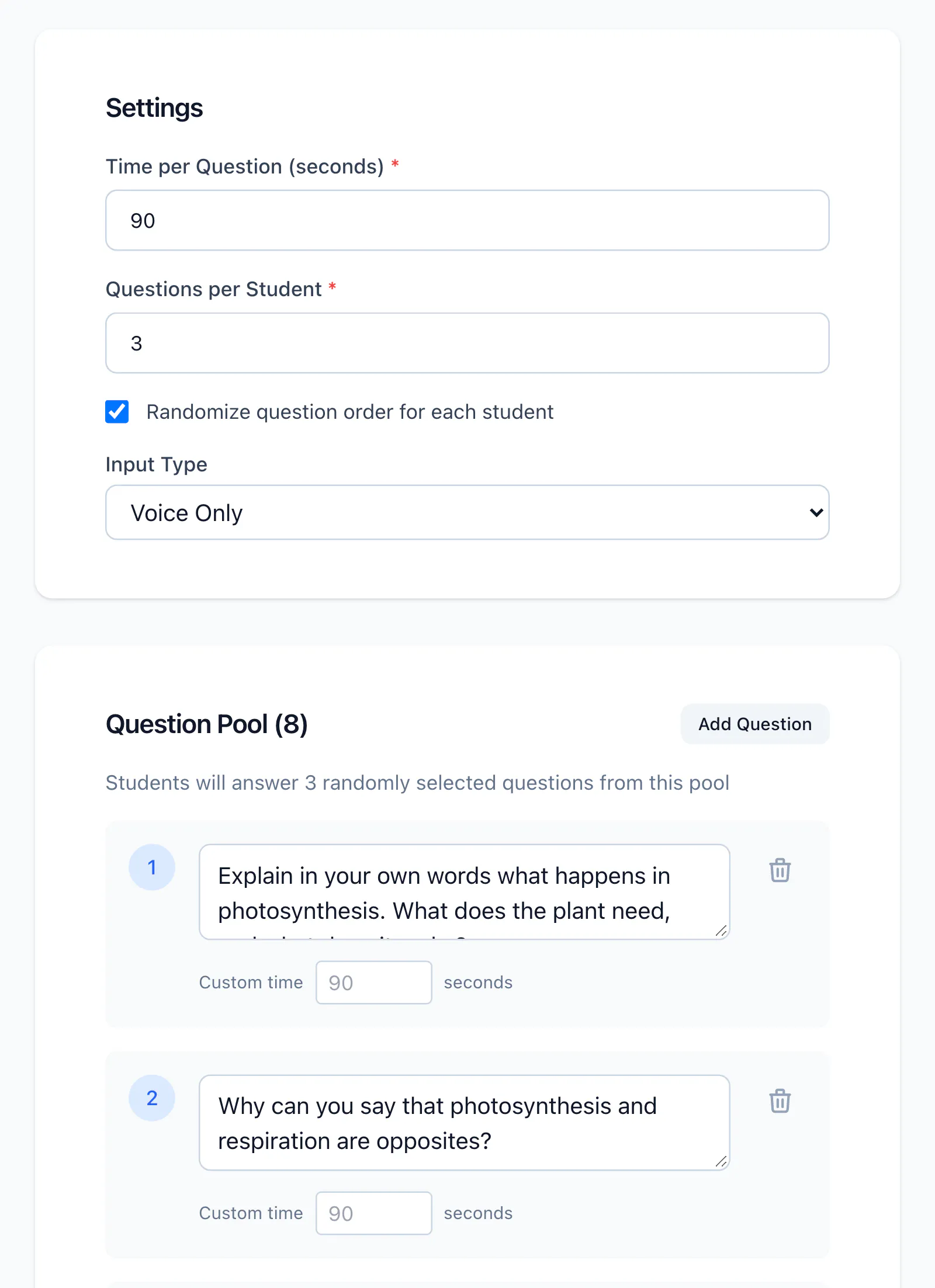
Build a pool of questions and decide how many each student gets. Set the time per question and a due date.
Students answer out loud
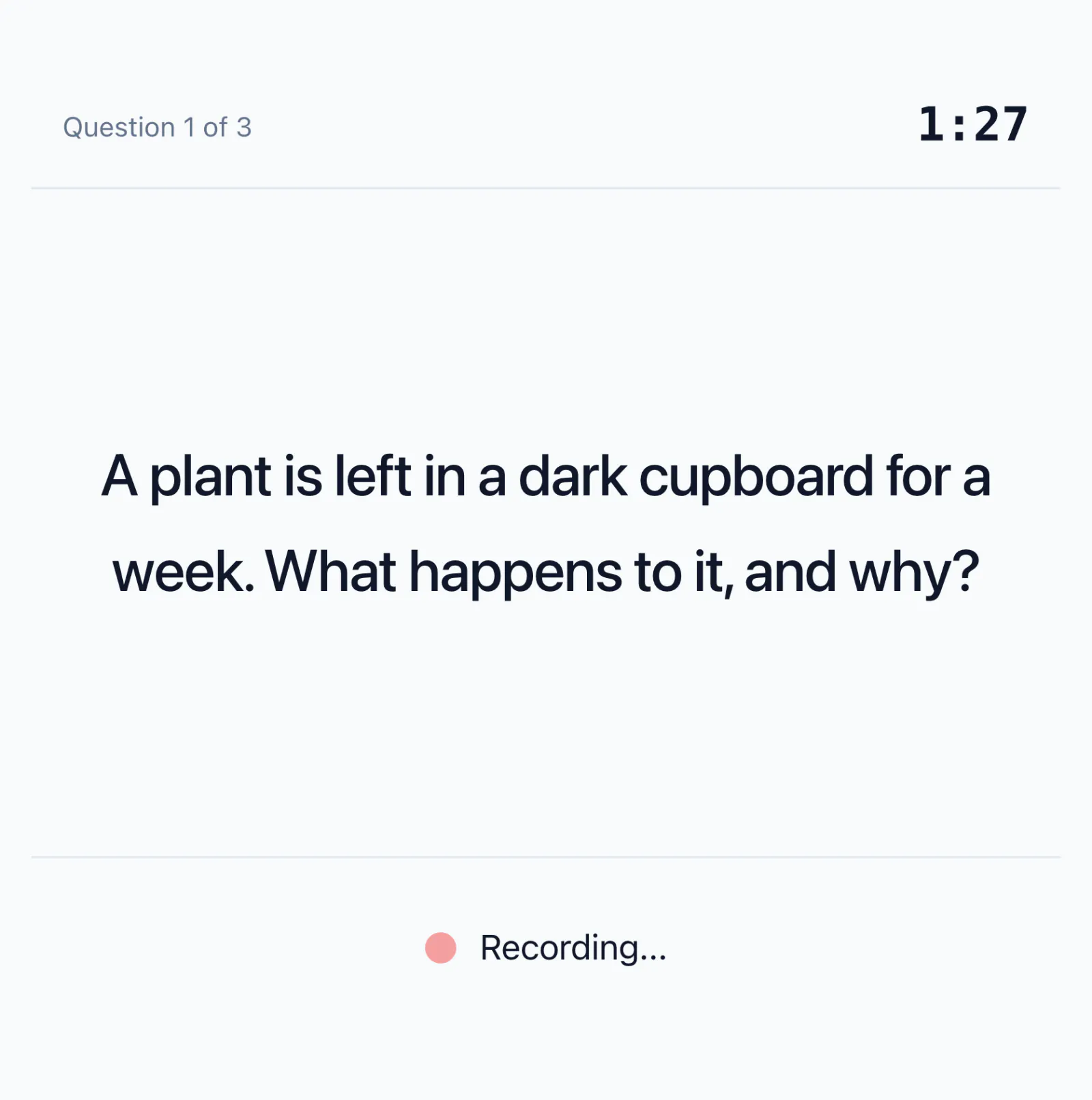
They open the assignment in the browser, check their microphone and answer one question at a time while the timer runs.
Read, grade, return
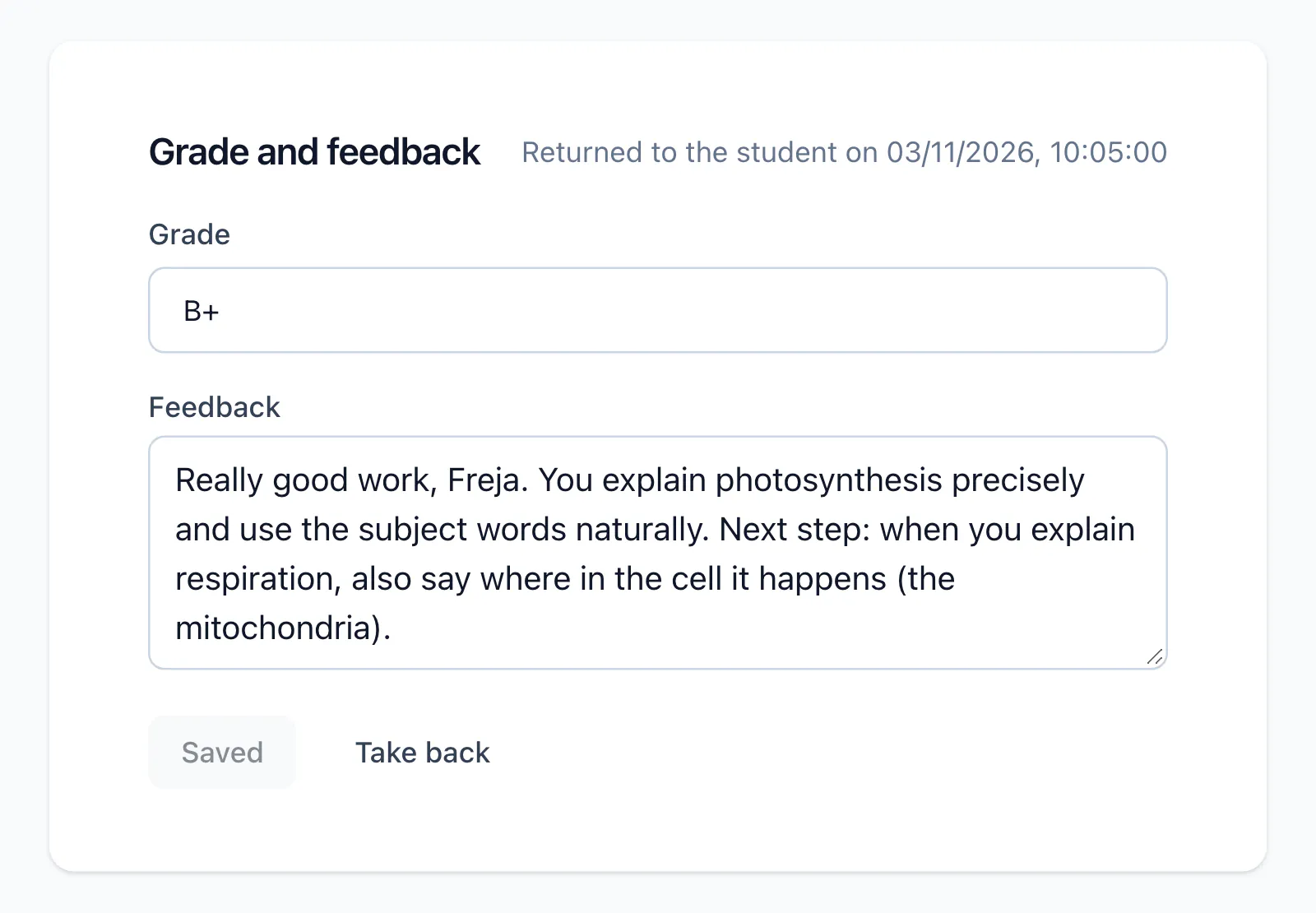
Read the transcript or listen to the recording, give a grade on your class's scale, comment on each answer and send it back.
Like an oral exam: everyone draws their own questions
Write eight questions and give each student three. Every student gets a random draw from your pool, in shuffled order if you like, so asking a classmate what they got for question 2 doesn't help.
Example: 8 questions in the pool, 3 per student, order shuffled.
Your question pool
- 1What happens in photosynthesis? (Freja)
- 2Why are photosynthesis and respiration opposites?
- 3A plant in a dark cupboard for a week (Freja)
- 4What does chlorophyll do?
- 5Why does pondweed bubble in the sun?
- 6Why do you get out of breath when you run? (Freja)
- 7Why is there more oxygen today?
- 8Show that plants take in CO₂
What you get
Every answer, transcribed
Each recording is transcribed word for word, in the language the student speaks. Read a whole class in the time it takes to listen to a few answers, and play the recording when tone matters. AI writes the transcript; the judging stays with you.
A plant is left in a dark cupboard for a week. What happens to it, and why?
I think it'll start going yellow and floppy. Because without light it can't do photosynthesis, so it can't make any new sugar. But it's still doing respiration the whole time, so it uses up the sugar it has stored. And when that's gone it has no more energy, and in the end it dies.
Your comment to Freja Nice link between photosynthesis and respiration. Why do the leaves turn yellow? Something to think about for next time.
See what happened during each answer
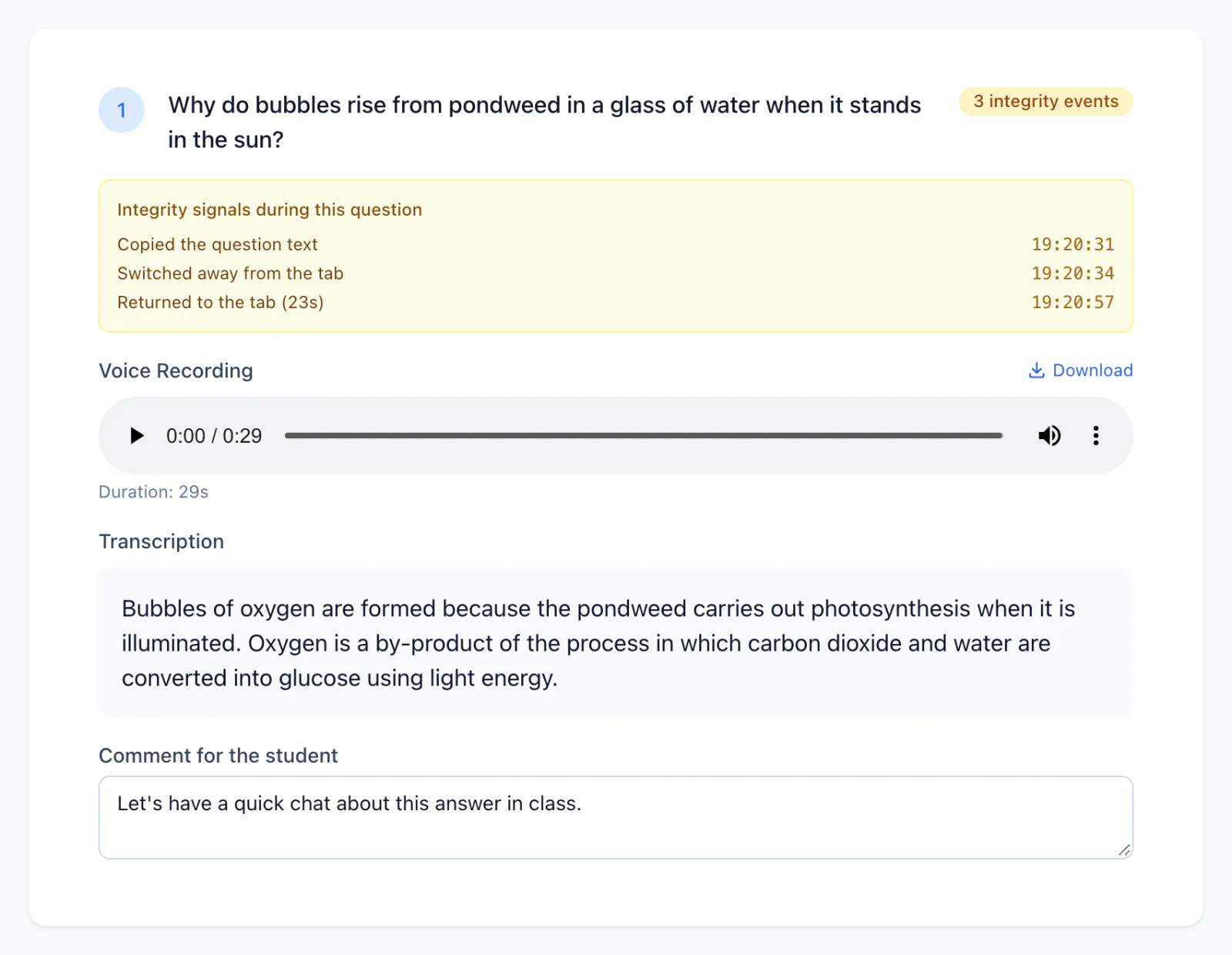
The assignment page notes when something unusual happens and shows it next to the answer it belongs to. It's information for you to weigh, not a verdict.
- Switching tab or window, and for how long
- Copying the question or trying to paste
- Right-clicking
- Muting or disconnecting the microphone
Feedback that reaches the student
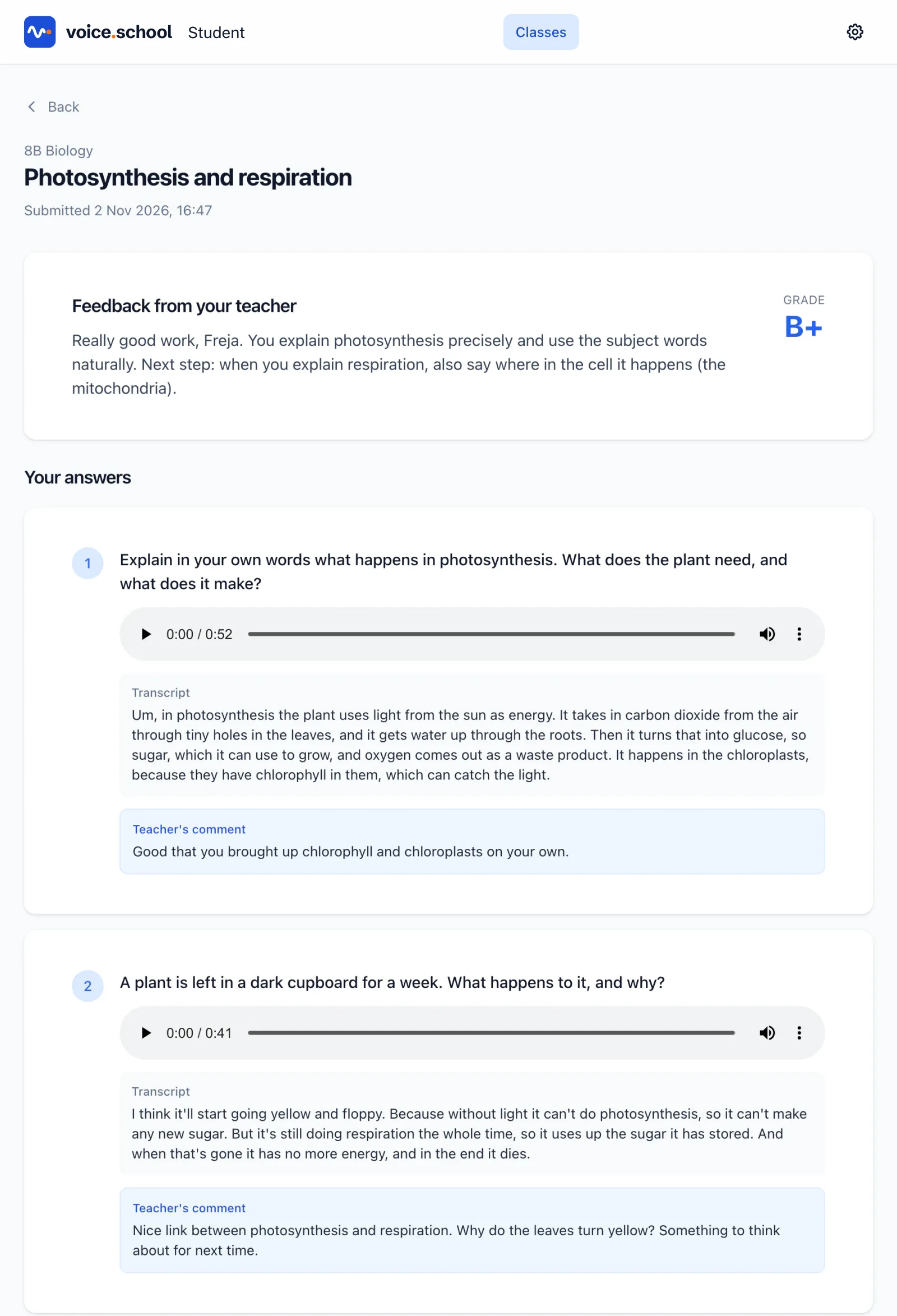
Give a grade on your school's scale, write overall feedback and add a comment to each answer. When you return the work, the student sees it all next to their own answers and gets an email.
And the practical things
- A timer per question
- One time for the whole assignment, or a custom time for the harder questions.
- Due dates, with an optional lock
- Late work is flagged. Lock the assignment at the deadline if you want to.
- Email notifications
- Students hear about new assignments, get a reminder 24 hours before the deadline and know when feedback is ready.
- 12 languages
- The whole app, for you and your students, in 12 European languages.
- Enterprise data retention
- Retention rules keep data no longer than it's needed. Transcripts and grades stay until you delete them.
- Free to get started
- No credit card and no trial period. Every feature is included.
Your school will ask about data. Here are the answers.
voice.school is built for European schools, starting with Denmark.
Read more for schools- Data stored in the EU
- A data processing agreement you can read today
- Enterprise data retention and deletion rules
- Deletion on request, or by the teacher in a few clicks
- Runs in the browser, nothing to install
Questions teachers ask
See all questionsCan't students just read an AI answer out loud?
They can try, but it's much harder than pasting one in. Each student draws their own questions from your pool, the clock is running, and the page notes it when they switch tabs or copy the question. Answers read from a screen also tend to sound like it, and you can listen to every recording. No tool stops a determined cheater, but this raises the bar a long way.
Does AI grade the answers?
No. AI only writes the transcript. You read or listen, decide the grade on your class's scale (for example A–F, 0–20 or the Danish 7-point scale) and write the feedback.
What do students need?
A browser and a microphone. There's nothing to install. They join your class with a code, and a microphone check before they start makes sure they can be heard.
Where is our data stored?
In the EU. Accounts, classes, recordings, transcripts and grades are all stored there, and each recording is transcribed automatically by an AI model. All subprocessors are listed on the subprocessors page.
Try it with one class this week
Create a class, write five questions and hear what your students say. It's free to get started, no credit card required.